
Assessment validation, with evidence attached to every judgement.
For a national skills organisation, we built a platform that validates assessment against the national training register, with a Recognition of Prior Learning component and analytics across the whole pipeline.
A national skills organisation working across Australia's vocational education and training system, responsible for keeping training and assessment aligned with what industry actually needs.
Assessment validation is high-stakes and manual. Tools must be checked against the units they assess: elements, performance criteria, knowledge evidence, assessment conditions. With thousands of interconnected training products, each in current and superseded versions, a single validation cycle involved extensive manual cross-referencing.
A use-case discovery phase mapped where AI could lift the most load, then we designed and built the platform: assessment validation at its core, a Recognition of Prior Learning component alongside it, and an analytics layer across everything.
Three capabilities, one workspace.
Assessment validation, cited
Assessment tools are validated against the training products they assess. The platform checks coverage of elements, performance criteria, knowledge evidence and assessment conditions, flags gaps, duplication and overreach, and attaches a citation to every finding. Validators start from an evidence-backed report instead of a blank checklist.
A Recognition of Prior Learning component
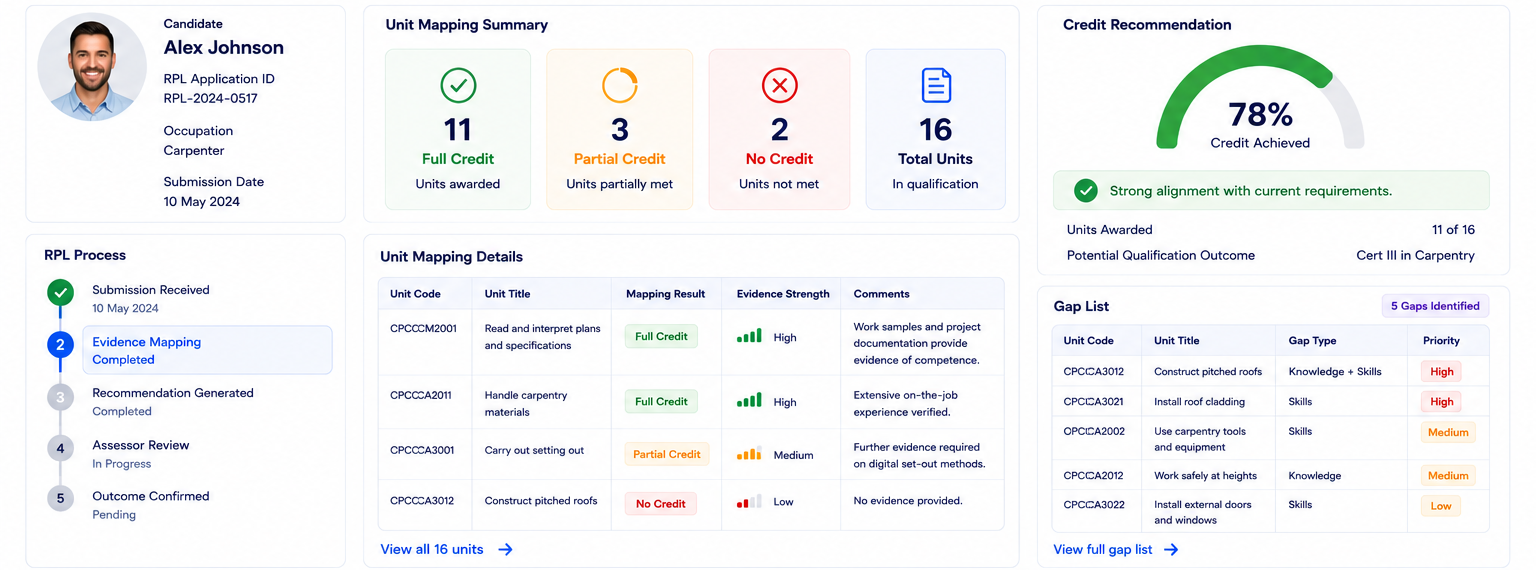
The same register grounding powers RPL. Candidate qualifications, including superseded versions, and workplace evidence are mapped against current unit requirements, producing a draft evidence mapping and gap list for assessor review. This is an RPL assessment recommendation, not credit transfer: the assessor makes the recognition decision, and the AI does not award anything.
Analytics across the pipeline
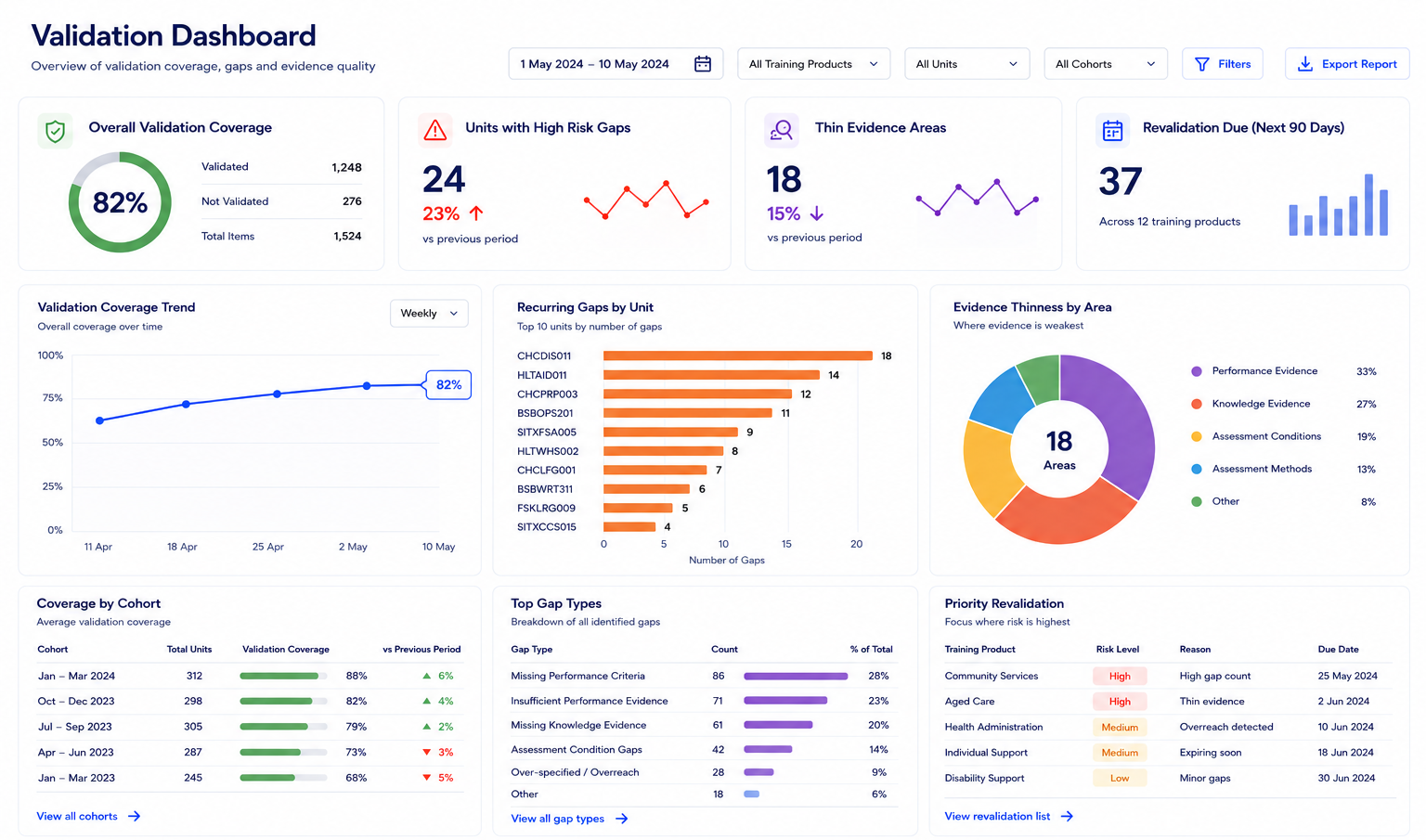
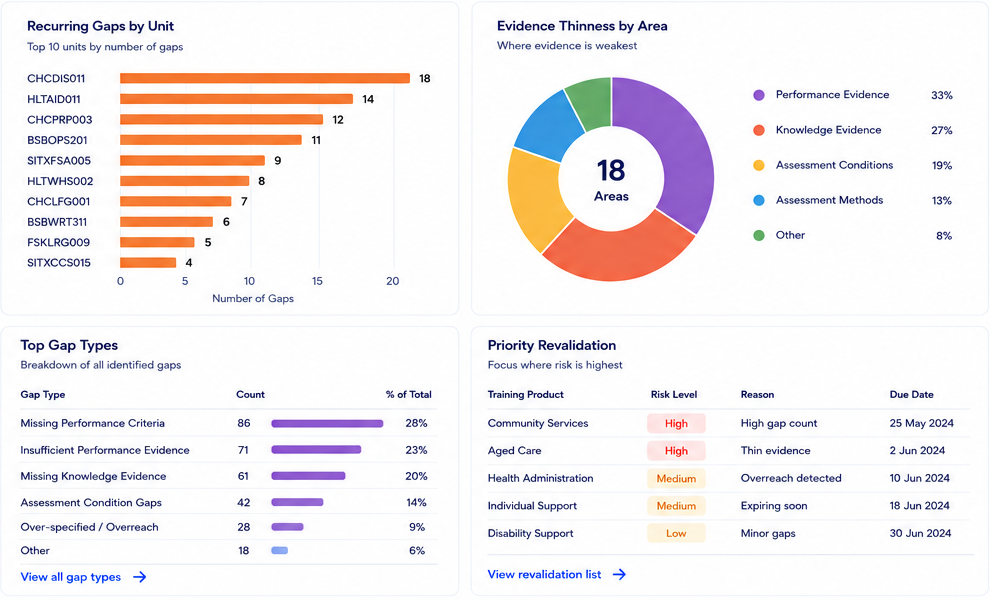
Dashboards show validation coverage, recurring gaps by unit and cohort, and where evidence runs thinnest. Quality teams prioritise revalidation where risk is highest, and walk into audits with the trend data already assembled.
The platform runs on a retrieval-augmented architecture over national training register data, indexed with Azure AI Search, so every finding is traceable to source content rather than model memory. Approval-conscious workflows, criterion-level flags and exportable evidence tables reflect the audit expectations of the VET sector.
Validators start each cycle from an evidence-backed report, with every finding carrying its citation. RPL assessors start from a draft evidence mapping rather than a folder of documents. Quality conversations start from data, not recollection.
Validation and RPL still done by hand?
Talk to us about register-grounded AI.
Discuss your AI project